The food supplements market is characterised by a wide variety of products, including capsules, tablets, oils and liquid formulations. For manufacturers, this diversity brings a range of different packaging requirements, particularly when it comes to dosing, counting, capping and labelling. This is why, in this article, we will help you identify the packaging solutions best suited to the activities and requirements of businesses operating in the food supplements sector.
Choosing the right filling or counting machine
Before selecting a packaging machine, it is essential to clearly define your products, existing processes and requirements. Not all food supplements require the same equipment: a bottle of capsules is packaged differently from a bottle of oil.
Capsules and tablets: automating the counting process
For solid food supplements, whether film-coated tablets or capsules, counting is the first stage of the packaging process. A counting machine makes it possible to automate this operation while reducing repetitive handling and the risk of errors.
For small and medium-sized production runs, the C-Pills is a semi-automatic counting machine specifically designed for capsules and film-coated tablets. It uses a vibrating hopper, a glass rotary table and a laser curtain counting system.
When production requirements increase, the C-Pills Auto takes automation a step further. Fully automatic, it counts capsules and film-coated tablets at speeds of up to 1,000 units per minute (size 0), with 99.99% accuracy.
Liquid food supplements: choosing the right dosing solution
Oils, plant extracts, drinkable solutions and other liquid formulations require a different approach. Here, the choice of dosing technology depends on several factors, including the product’s viscosity and conductivity, the volume to be dispensed and its behaviour during filling (such as foam formation), among other considerations.
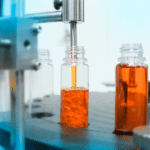
For small and medium-sized production runs, a solution such as the K-One can handle filling volumes ranging from 5 ml to 1 litre. Equipped with a peristaltic pump, it can operate in semi-automatic mode or automatically thanks to its straightforward integration into an existing machine. The product only comes into contact with the tubing, making product changeovers and cleaning operations easier.
For larger volumes, an automatic filling machine such as the K-Net Auto or the K-Line S may be considered. The number of filling nozzles, dosing system and machine configuration can all be adapted to your requirements, including production speed, accuracy and the characteristics of the product being dispensed.
Next, automate the capping of your supplement containers
Once the product has been counted or dosed, the container must be securely closed. Depending on the type of container and closure, several operations may be required, including cap placement, pressing or screw capping.
To automate this stage, we offer solutions such as the VS 2000. This automatic screw capping machine feeds caps onto containers before tightening them. It can handle up to 30 products per minute and accommodate a wide range of caps, from 20 to 75 mm in diameter. Its automatic cap feeding system eliminates the need to position each cap manually before tightening. The tightening torque and various operating parameters can be adjusted directly via its touchscreen.
For manufacturers packaging several product references, the choice of closure system must also take into account format changeovers and the specific characteristics of the caps being used.
Do not overlook labelling and traceability for your food supplements
The label identifies the product and its brand, while also communicating essential information to consumers, including ingredients, directions for use, precautions and applicable regulatory information. To achieve consistent results, the choice of labelling machine must take into account the shape and diameter of the container, the number of labels required and any specific positioning constraints.
For small cylindrical containers and short production runs, the Ninette Auto Mini is a semi-automatic solution worth considering. For higher production volumes, an automatic labelling machine such as the Ninon 2500 can meet more demanding throughput requirements.
A packaging installation can also be complemented with marking systems to apply variable information, such as batch numbers or dates, depending on the manufacturer’s traceability requirements.
Complete packaging line or gradual automation: which strategy should you adopt?
Automating your packaging process does not necessarily mean replacing all your existing equipment. The right level of automation depends above all on production volumes, workshop organisation, the number of product references and future growth prospects.
Start by automating an individual packaging station
For a small-scale producer, laboratory or SME looking to improve productivity without immediately committing to a significant investment, gradual automation can be a relevant strategy. It is possible to start by automating capsule counting, bottle filling or labelling, before integrating additional equipment as requirements evolve.
Bring several operations together on a complete packaging line
As production volumes increase, bringing several stages together within a single installation helps streamline container handling and reduce manual intervention between workstations.
This is precisely the principle behind our C-Pills Auto – VS 2000 – Ninon 2500 complete packaging line.
This configuration combines three complementary machines:
- The C-Pills Auto automatically counts capsules and tablets.
- The VS 2000 feeds and screw-caps the containers.
- The Ninon 2500 applies labels to cylindrical bottles.
Together, these machines automate the successive stages of counting, capping and labelling, reducing handling between the different operations.
For liquid food supplements, an alternative configuration can be developed around a filling machine, a screw capping machine and a labelling machine.
Would you like to automate the packaging of your food supplements? Contact our teams to discuss your project and identify the solution best suited to your products, containers and production targets.
FAQ: automating food supplement packaging
Which machine should you choose for packaging capsules and tablets?
The choice depends primarily on production volume and the level of automation required. A semi-automatic counting machine such as the C-Pills is suitable for production processes that require a degree of flexibility. For larger volumes, the C-Pills Auto automates the counting of capsules and film-coated tablets.
How can you automate the packaging of liquid food supplements?
The first step is to identify the characteristics of the liquid, including its viscosity, the volume to be dispensed and its behaviour during filling. A filling machine such as the K-One may be suitable for small volumes and growing production operations. For higher production speeds, an automatic solution can be considered.
Can counting, capping and labelling be automated on a single line?
Yes. Our C-Pills Auto – VS 2000 – Ninon 2500 line combines an automatic counting machine, a screw capping machine and a labelling machine. It allows all three operations to be carried out successively within a single installation.
Is it possible to automate a packaging line gradually?
Yes. It is entirely possible to start with an individual machine and then expand the installation by adding further equipment. This approach allows investment to be spread over time and packaging capacity to evolve in line with business requirements.
A lire également :
 Food Supplement Packaging: What Are the Key Challenges?
 The Specific Requirements of Household Product Packaging
 Which Machine Should You Choose to Package Multiple Formats on the Same Production Line?
 How Does the Engineering Department Turn a Customer Requirement into a Solution?
 Manual, Semi-Automatic or Automatic Capping: When Should You Switch to a Different Solution?
 CFIA 2024
 CDA, almost 10 years of filling