The pharmaceutical sector is one of the most demanding in terms of precision, traceability and compliance. In a context where every vial, bottle or carton must be packaged with the utmost reliability, the choice of packaging machinery becomes a key success factor for laboratories, manufacturers of therapeutic solutions and other pharmaceutical products.
For over 35 years, CDA has been designing and manufacturing a complete range of machines: from fillers to labellers, including cappers and monobloc systems tailored to pharmaceutical packaging. So why do these machines represent added value for the pharmaceutical industry, and how can they optimise the productivity of your packaging lines?
Why specific machinery for pharmaceuticals?
Pharmaceutical packaging differs significantly from that of other industries:
- Ultra-precise dosing systems for critical volumes,
- Strict hygiene and regulatory compliance requirements,
- Essential traceability right through to the end consumer.
This is why it is crucial to choose a packaging solution that is suitable, high-performing and reliable.
Our working method: from needs analysis to on-site validation
At CDA, every project begins with an in-depth analysis of requirements. In this sector, these requirements are defined through detailed specifications. This analysis enables us to precisely identify the technical, regulatory and production constraints specific to each project. Our technical, sales and Research & Development teams work closely together to provide a solution perfectly aligned with the client’s objectives: output rate, product types, container formats, traceability requirements and integration into existing lines. Because every packaging line has its own specific features, we offer the possibility of “tailor-made” modifications, particularly in terms of machine guarding, to optimise ergonomics, safety and integration into production processes. This personalised approach is supported by a rigorous methodology, including the implementation of FAT (Factory Acceptance Test) and RT (acceptance tests), ensuring equipment compliance prior to final installation and commissioning. These validation stages are essential in the pharmaceutical sector to guarantee performance, reliability and regulatory compliance.
Enhanced support through CDS and its Qualiopi certification
Beyond machinery, CDA also relies on the expertise of CDS, whose Qualiopi certification is a genuine mark of quality in training and team support. In a sector as demanding as pharmaceuticals, this certification provides significant added value in terms of operator upskilling, process control and operational safety. It reflects our commitment to supporting our clients over the long term, not only in terms of equipment, but also in operational performance and the transfer of know-how.
CDA innovations
At CDA, we do more than simply supply machines: our Research & Development team continuously designs and improves solutions tailored to the strict requirements of various industries. Each project involves an in-depth study of customer needs, production constraints and applicable regulations, in order to deliver machines that are reliable, precise and scalable. Our R&D department works hand in hand with our production teams to develop unique features that address sector-specific challenges. Among the solutions particularly suited to the pharmaceutical sector, the C-Pills and C-Pills Auto occupy a strategic position. These counting machines, semi-automatic and automatic respectively, have been specifically designed for the packaging of capsules, coated tablets and other solid forms requiring flawless counting accuracy.
C-Pills perfectly meets the needs of flexible production or lower output rates, while C-Pills Auto enables full process automation for higher volumes, with a significant reduction in human error and an improvement in productivity. These machines can be easily integrated into a complete line including filling, capping and labelling, while meeting the compliance requirements specific to the pharmaceutical industry.
Discover how CDA machines can transform your pharmaceutical packaging line. Contact our experts today for a tailored solution.
FAQ: Pharmaceutical Packaging
What types of pharmaceutical products can be packaged using CDA machines?
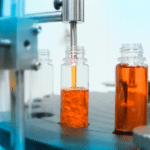
CDA machines can package a wide range of pharmaceutical products: free-flowing liquids, viscous solutions, gels, syrups, tablets, capsules, etc. Each solution is tailored to the product, container and dosing or counting requirements.
Does CDA offer customised machines for the pharmaceutical industry?
Yes, CDA designs and manufactures customised solutions based on a detailed analysis of specifications. Our teams can adapt lines according to required output rates, container formats, integration constraints and specific needs.
Why are FAT and RT tests important in a pharmaceutical packaging project?
FAT (Factory Acceptance Test) and RT (acceptance tests) are used to validate machine performance, compliance and proper operation before delivery and during on-site installation. These steps are essential to ensure line reliability and compliance with strict pharmaceutical standards.
What is the difference between C-Pills and C-Pills Auto?
C-Pills is a semi-automatic counting machine ideal for flexible or medium-scale production. C-Pills Auto is fully automated and better suited for high-productivity lines, ensuring precise counting of tablets and capsules while reducing operator errors.
How does CDA ensure regulatory compliance of its equipment?
From the design stage, CDA integrates requirements for precision, traceability, cleanability, hygiene and safety specific to the pharmaceutical sector. Each project undergoes a detailed technical study to meet current regulations and constraints.
What support does CDA provide after machine installation?
Beyond supplying equipment, CDA supports clients with commissioning, validation testing, team training and line optimisation. This support is reinforced by CDS expertise and its Qualiopi certification.
What are the advantages of a monobloc system for the pharmaceutical industry?
Monobloc systems combine several operations within a single machine: filling, capping, counting and labelling. This solution optimises space, improves productivity and reduces handling, while enhancing process reliability.