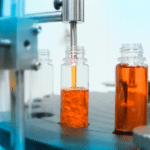
Packaging plays a strategic role in business performance. Whether for small or large-scale production, and whether your products are liquid, viscous, pasty or foamy, the quality of your packaging equipment has a direct impact on productivity, brand image and profitability.
Given the wide variety of requirements, one question comes up repeatedly: which packaging machine should you choose according to your production rate? A small artisan batch obviously does not have the same constraints as a line designed for high-volume production.
Between semi-automatic fillers, automatic cappers, industrial labellers and monobloc systems integrating several functions, it is essential to select equipment suited to your production pace and your sector of activity. For more than 35 years, CDA has been designing packaging solutions for a wide range of industries: food processing, cosmetics, e-liquids, chemicals, essential oils, para-pharmaceuticals and wine production.
Why Adapt Your Packaging Machine to Your Production Rate?
Choosing an under-sized machine can quickly become a limitation. Conversely, investing in a line that is too complex or too fast can generate unnecessary costs and inefficient operation.
Your production rate is a key factor. This information directly influences:
- the type of machine to install;
- the desired level of automation;
- the number of filling stations required;
- capping systems;
- labelling speed;
- product format management;
- line ergonomics.
A precise analysis of your requirements allows you to select the most profitable and scalable packaging solution. Our experts support you in analysing this information.
Fillers for Small-Scale Production
Semi-Automatic Fillers: Ideal for Small Production Runs
For artisans, laboratories and start-ups, a semi-automatic filler is often the best compromise between budget, precision and flexibility. Machines such as the K-One, the K-Net, the Piston Trolley and the C-Pills enable efficient packaging of small and medium production runs while maintaining excellent dosing accuracy. The models developed by CDA ensure precise filling, even for small containers.
When Should You Choose a Semi-Automatic Filler?
A semi-automatic machine is ideal when:
- production remains below a few thousand units per day;
- format changes are frequent;
- available production space is limited;
- the operator retains a central role in the process.
Automatic Fillers: For High Production Rates
As production volumes increase, automatic fillers become essential. They make it possible to achieve high production rates while guaranteeing:
- reduced product loss;
- improved repeatability;
- lower labour costs.
CDA automatic fillers are designed to integrate easily into complete packaging lines.
Among the flagship models:
Cappers: Ensuring Reliable and Fast Sealing
Once the product has been filled, the capping stage begins.
Semi-Automatic Cappers
For small production runs, a semi-automatic capper simplifies operators’ work while ensuring consistent tightening torque. These machines (VS50, VS100) are particularly useful for small batches.
Automatic Cappers
The models developed by CDA can handle different types of caps and achieve high production rates with excellent precision.
The automatic cap distribution and capping systems featured on the VS 2000 significantly reduce handling times and improve overall productivity.
Labellers: Enhancing the Value of Your Products
The label is often the consumer’s first visual contact with the product. Poor label application can negatively affect the perceived quality of the product.
Semi-Automatic Labellers
Semi-automatic labellers are perfectly suited to small production runs or varied batches. CDA notably offers:
These solutions are particularly suitable for artisan producers, laboratories and SMEs.
Automatic Labellers for High Production Rates
Automatic lines enable rapid labelling of large quantities of containers with consistent precision.
The Solo, developed by CDA, as well as the Ninon Mix, are labellers suitable for a wide range of containers (including bottles, flasks, jars, jerrycans, tins, etc.).
Monobloc Systems: A Compact and High-Performance Solution
Packaging monobloc systems are experiencing strong growth. Why? Because they combine several functions within a single machine: filling, capping and labelling.
They are particularly beneficial when:
- production space is limited;
- format changes are frequent;
- several operations need to be automated;
- production rates must remain high.
CDA monobloc systems such as the E-Fill SW can package containers ranging from 5 ml to 250 ml (and beyond, depending on the project).
The Importance of a Scalable Machine
Choosing a packaging machine should never be limited to current requirements alone. A growing business must be able to:
- increase production rates;
- add new formats;
- integrate new products;
- progressively automate its line.
The equipment designed by CDA is developed to support the evolution of your production. Our experts assist you throughout your packaging projects in order to provide scalable lines that grow alongside your business activities. The choice of a packaging machine depends above all on your production rate, technical constraints and growth objectives.
Between fillers, cappers, labellers and monobloc systems, each solution meets specific requirements. A small business will favour flexible semi-automatic equipment, while intensive production will require machines capable of maintaining high output rates.
By relying on CDA’s expertise, you benefit from reliable, scalable packaging solutions tailored to your business.
Looking for a Packaging Solution Adapted to Your Production Rate? Contact the CDA teams to benefit from personalised support in choosing your future packaging line.
FAQ: Industrial Packaging
What is the difference between a semi-automatic and an automatic filler?
A semi-automatic filler requires operator intervention, whereas an automatic filler integrates a conveyor system to automate product transfer.
At what production rate should you switch to an automatic machine?
Switching to an automatic line depends on production volume, the number of packaged product references and productivity requirements. Generally, automatic machines become relevant as soon as production rates increase significantly or production becomes continuous.
Why choose a packaging monobloc system?
A monobloc combines filling, capping and labelling within a single compact machine. This reduces floor space requirements and improves production flow.
Are CDA machines suitable for small production runs?
Yes. CDA offers both semi-automatic solutions for small batches and automatic lines for large-scale industrial production.
How can you scale your packaging line as your business grows?
A packaging line must be able to evolve alongside your production requirements. Moving from a semi-automatic filler to a monobloc or a fully automated line allows production rates to increase progressively. Our experts support you throughout these decisions and developments.